


Your Complete Guide to Driving on Coimbatore’s GD Naidu Flyover: Tips & Key Details
To reduce the heavy traffic on Avinashi Road, the Highways Department decided to build this high-level bridge. The project cost was ₹1,791.23 crore, work started in December 2020, and it is now ready.
With the recent inauguration of the GD Naidu Elevated Expressway, Coimbatore has proudly claimed the title for having the longest flyover in South India. This 10.1-kilometer engineering marvel, officially opened by Chief Minister M.K. Stalin on October 9, 2025, promises to revolutionize travel across the city’s bustling Avinashi Road corridor . Named after the legendary inventor and industrialist G.D. Naidu, fondly remembered as the ‘Edison of India,’ this flyover isn’t just a transportation project but a symbol of Coimbatore’s spirit of innovation and progress.
For drivers, this new infrastructure means saying goodbye to the notorious 45-minute crawl along Avinashi Road and welcoming a remarkably smooth 10-minute journey between crucial points in the city, especially to the Coimbatore International Airport . Whether you’re a daily commuter, a commercial vehicle operator, or someone visiting the “Manchester of South India,” this comprehensive guide will help you navigate this flyover with confidence, safety, and efficiency.
Key Specifications of the GD Naidu Expressway Flyover
Before hitting the road, it’s helpful to understand the scale of this project:
| Official Name | G.D. Naidu Elevated Expressway (also known as Avinashi Road Flyover) |
| Length | 10.01 km (6.22 miles) |
| Width | 17.25 meters wide |
| Project Cost | Approximately ₹1,791 crore |
| Northern Terminus | Uppilipalayam |
| Southern Terminus | Goldwins |
| Pillars | 304 pillars |
| Travel Time Saving | Reduces travel time to airport from city to 10 minutes |
| Lanes | A 4-lane flyover above and 6-lane road below — 10 lanes in total. |
| Special For | longest high-level flyover in South India |
Navigating the Route & Access Ramps At Avinashi Road Flyover
Entry & Exit Points in the Flyover
Avinashi flyover is designed to bypass approximately 12 major traffic intersections along the Avinashi Road, one of the city’s busiest arterial routes . This includes major junctions like Airport, Codissia, Hope College, Nava India, Lakshmi Mills, and Anna Statue.
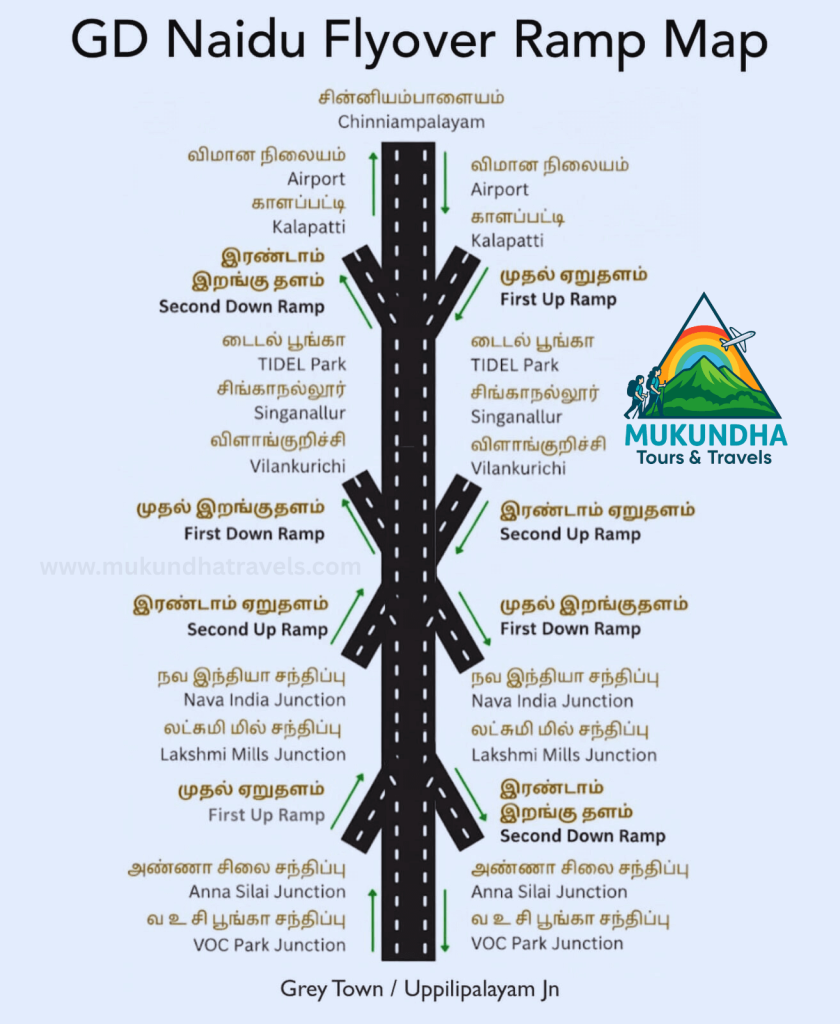
Getting on and off the flyover is easy because of its smart design. The government built special ramps in busy areas. This lets people get on or off the raised highway where traffic is worst.
To ensure seamless access, the GD Naidu flyover features eight ramps (4 ups and 4 downs) at strategic locations . The officially specified ramp locations are at:
- Anna Statue
- Nava India
- Hope College
- Coimbatore Airport
From Uppilipalayam to Goldwins: You can get on the flyover at Anna Statue and Peelamedu. You can get off at Hope College and the Airport.
From Goldwins to Uppilipalayam: You can get on at the Airport and Hope College. You can get off at Peelamedu and Anna Statue.
This means you don’t have to drive the full 10 km if you don’t need to. You can get on the flyover, skip a few crowded junctions, and get off closer to where you are going.
These ramps are crucial for distributing vehicular movement to other arterial roads without needing to descend the entire flyover. Be sure to plan your route in advance and move to the appropriate lane well before your intended exit.
A simple tip: Know which ramp you need to take before you start driving. Move into the correct lane early so you can exit smoothly and safely.
Essential Driving Tips for Elevated Highways
Driving on a long, elevated structure like the GD Naidu Flyover presents unique challenges compared to regular city driving. Adhering to these tips will ensure not only your safety but also a smooth experience for all road users.
1. Master Speed and Lane Discipline
- Observe Speed Limits: While the flyover makes high speeds easily attainable, always adhere to posted speed limits. The wider road and lighter traffic can be deceptive, and maintaining a controlled speed is crucial for safely responding to any unexpected situations.
- Maintain Lane Discipline: The right-most lane is traditionally the fast lane, meant primarily for overtaking. Avoid using it as a regular driving lane. A slow-moving vehicle in the fast lane can become a significant hazard for faster-moving traffic.
- Signal and Check Blind Spots: Always use your indicators when changing lanes. Check your mirrors regularly and be aware of blind spots. If your vehicle is equipped with blind-spot mirrors, they can be particularly helpful on such multi-lane roads.
2. Maintain Safe Distance and Be Weather-Aware
- Follow the Three-Second Rule: Keep a safe distance from the vehicle ahead of you. To apply the three-second rule, note when the car in front passes a fixed object (like a signboard), and ensure it takes at least three seconds for you to reach the same point. Increase this gap at night or during rain.
- Adjust for Wet Conditions: The flyover is equipped with modern features, but wet roads are always a risk. In rain, reduce your speed, avoid sudden braking, and steer clear of puddles to prevent hydroplaning, where your tires lose contact with the road surface.
- Anticipate Crosswinds: As an elevated structure, the flyover can be exposed to strong crosswinds, especially on windy days or after passing a gap between sound barriers. Firmly grip your steering wheel and be extra cautious when overtaking larger vehicles like buses or trucks, as they can be significantly affected by wind.
3. Prepare for Uphill and Downhill Sections
- While the gradient is designed for comfort, understanding basic slope driving can enhance control.
- Uphill Driving: Maintain a steady speed. For manual transmission vehicles, if the slope feels steep, it’s best to stay in a lower gear to maintain power without straining the engine.
- Downhill Driving: The key is to avoid riding the brakes. For better control, engage a lower gear (like ‘2’ or ‘L’ in an automatic) to use engine braking, which helps prevent your brakes from overheating. Never coast downhill in neutral.
Unique Features and Safety Systems in New Avinashi Flyover
The GD Naidu Flyover isn’t just a concrete structure; it incorporates several innovative and eco-friendly features:
- Rainwater Harvesting: It is Tamil Nadu’s first flyover with a full-fledged rainwater harvesting system in every span, designed to improve groundwater recharge. (There are over 20 rainwater collection systems.)
- Expansion Joints: It uses advanced sinus plate expansion joints for a smoother and more durable riding surface.
- Irrigation and Lighting: The project includes drip irrigation on the flyover itself and sprinkler systems at the ground level, along with energy-saving lights for better visibility and efficiency.
- Railway Crossing: The elevated corridor seamlessly crosses over a railway line, eliminating a major traffic choke point and ensuring an uninterrupted journey.
- Special Construction: Near the Hope College junction, the flyover goes over a railway bridge. A special 52-meter long, 725-tonne iron girder was built in a private factory in Thennampalayam and placed on the pillars here.
The G.D. Naidu Elevated Expressway stands as a testament to Coimbatore’s growth and a solution to its long-standing traffic woes. It is more than just a road; it is a gateway that enhances connectivity not just within the city, but also to surrounding regions like Salem, Erode, and Tiruppur.
As you experience the convenience of this remarkable infrastructure, remember that safe driving practices are what will ultimately make every journey pleasant and secure. Embrace this new urban landmark, enjoy the time you save, and always prioritize safety for yourself and your fellow commuters.
Drive safely, and welcome to the future of travel in Coimbatore!